X_eTaL-fpga
X_eTaL programs as hardware: a typed array program becomes a circuit, simulated and checked bit for bit against the X_eTaL evaluator, and on its way to a Tang Nano.
c := a + b on eight 16-bit numbers is eight adders; '+ r_/ v is a tree of adders; a step function over a state vector is registers and the logic between them. Every example here is an X_eTaL program first. Its output is the reference, and the intermediate form, the simulated circuit and the generated Verilog must all reproduce it. The first machine, HEX1000, is a 4-bit calculator in the spirit of the TI TMS1000, sized for a Tang Nano 1K; larger machines go to the Tang Nano 9K and 20K and the Tang Primer boards.
            X_eTaL program (.xtl)
                    |
   +----------------+----------------+
   v                v                v
evaluator    intermediate form   simulated circuit, Verilog
   |                |                |
   +----------------+----------------+
                    v
             the same answers
HEX1000
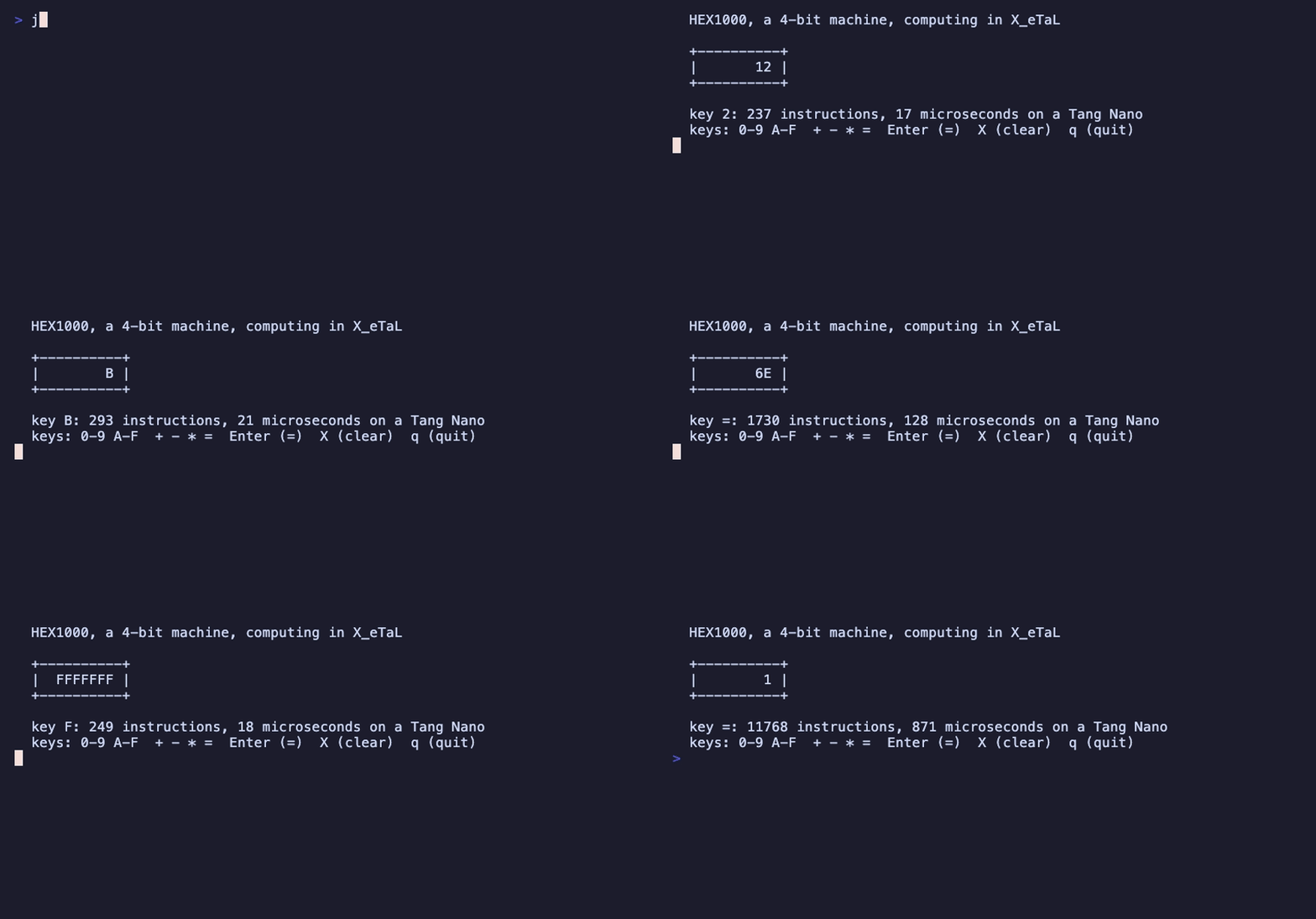
A 4-bit machine of our own design in the spirit of the TMS1000: a 4-bit accumulator, 64 words of 4-bit RAM, a ROM of 1024 instructions, a program counter that steps as a shift register (docs/machine.md). It is written in X_eTaL (the Hex1000 library: one instruction is a pure step function of the machine's state), and its ROM holds a program in its own instructions (rom/calc.asm, about 330 of them) that makes it an eight-digit hexadecimal calculator. Keys go in through its key matrix and the digits come out on its output latches, nothing else computing; every screen is checked against the specification, the Radix library. The screens below were made by running it while this page was built:
| Keys typed | Screen |
|---|---|
12+34= | 46 |
FF+1= | 100 |
A*B= | 6E |
C0DE+BEEF= | 17FCD |
5-7= | FFFFFFFE |
FFFFFFFF+1= | 0 |
2*3+4= | A |
FFFFFFFF*FFFFFFFF= | 1 |
12+34= takes the machine 1752 instructions, FFFFFFFF*FFFFFFFF= 16406: on a Tang Nano at 13.5 million instructions a second, about a millisecond. Try HEX1000 in your browser: the same program, X_eTaL running in the page. Or at a terminal: clone the repository and run just calc (keys 0-9 A-F + - * = X, q to quit); just demo-lib Hex1000 listing shows its ROM, page by page. Next: the machine as a circuit, then on a Tang Nano 1K.
Libraries
Each links to its documentation, generated by xetal doc from the ## comments in its source; every ## >> example there is run as a test. The documentation index also has the demo programs, a search, the built-ins, and each source file.
| Library | Alias | What |
|---|---|---|
| Clocked | ck: | clocked circuits as X_eTaL step functions: counters, accumulators, shift registers, a sequence detector, a RAM, and the harness that clocks them |
| Datapath | dp: | the vector examples at a stated width: the whole-array operations a circuit realizes directly |
| Fixed | fx: | fixed-width two's complement numbers at a stated width, the arithmetic a w-bit circuit does |
| Hex1000 | hx: | HEX1000, a 4-bit machine in the spirit of the TMS1000: its state, one instruction as a pure step, a run harness, an assembler |
| Radix | rx: | an eight-digit calculator in any radix (hexadecimal, octal, decimal): the specification HEX1000's ROM program must meet |
| Uart | ua: | a serial port (UART: 8 data bits, no parity, 1 stop bit) as X_eTaL step functions: a transmitter, a receiver, and the two looped back |
Circuits
The Verilog-2005 of every example circuit, as pinned in the repository. Each is checked by a simulator of the same netlist against the X_eTaL evaluator, and every module passes its self-checking testbench under iverilog, Verilator's lint and Yosys's synthesis.
| Library | Module | Schedule |
|---|---|---|
| Clocked | accumulator.v | Clocked: registers from reset, one stream item per clock. |
| Clocked | counter.v | Clocked: registers from reset, one stream item per clock. |
| Clocked | detect.v | Clocked: registers from reset, one stream item per clock. |
| Clocked | ram.v | Clocked: registers from reset, one stream item per clock. |
| Clocked | shift.v | Clocked: registers from reset, one stream item per clock. |
| Datapath | pipeline.lanes1.v | Temporal schedule: 1 lane(s), done after 8 clock(s) from reset. |
| Datapath | pipeline.v | Spatial schedule: 8 lane(s), combinational. |
| Datapath | reduce-sum.lanes1.v | Temporal schedule: 1 lane(s), done after 8 clock(s) from reset. |
| Datapath | reduce-sum.v | Spatial schedule: 8 lane(s), combinational. |
| Datapath | saxpy.lanes1.v | Temporal schedule: 1 lane(s), done after 8 clock(s) from reset. |
| Datapath | saxpy.v | Spatial schedule: 8 lane(s), combinational. |
| Datapath | threshold.lanes1.v | Temporal schedule: 1 lane(s), done after 8 clock(s) from reset. |
| Datapath | threshold.v | Spatial schedule: 8 lane(s), combinational. |
| Datapath | vector-add.lanes1.v | Temporal schedule: 1 lane(s), done after 8 clock(s) from reset. |
| Datapath | vector-add.v | Spatial schedule: 8 lane(s), combinational. |
| Fixed | counter.v | Clocked: registers from reset, one stream item per clock. |
| Hex1000 | hex1000.v | Clocked: registers from reset, one stream item per clock. |
| Uart | loopback.v | Clocked: registers from reset, one stream item per clock. |
Documents
- docs/plan.md: the plan: architecture decisions and the roadmap
- docs/machine.md: HEX1000, the 4-bit machine
- libs/Hex1000/docs/calc.md: HEX1000's calculator program: its ports, RAM, pages and costs
- docs/hardware.md: Verilog, the checks from the evaluator to the bitstream, testing on a board
- docs/boards.md: the Tang boards: families, resources, software
- docs/calc-approaches.md: calculators, state and data: the discussion and its decisions
- docs/xetal-asks.md: what this repository needs from X_eTaL
- CHANGES.md: every commit